Current Issue

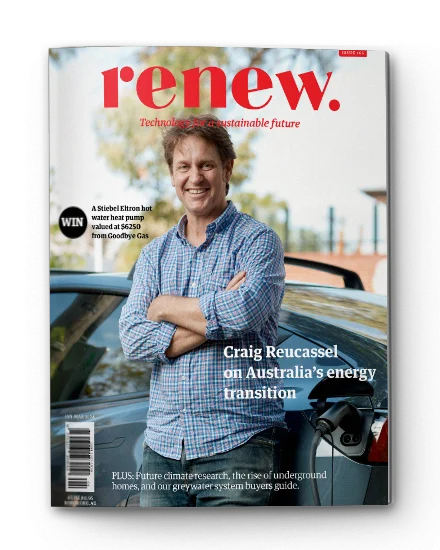
ReNew 112 highlights

Ar-chee's kennel featured in ReNew 112

Canberra’s best solar cat

Hooray for passive solar kennel design, especially when you’re a Canberra cat, writes Sarah Dailey.

READ MORE »

As Canberra is in the midst of a typically frosty week, we were sure you were all wondering how Ar-Chee the cat is faring.

For those of you who read Julian Edgar’s story about his cleverly constructed $15 solar pet kennel in ReNew 112, we thought you’d all be dying to know just how warm and settled Ar-Chee is in his luxurious new digs. Well, rest assured dear reader.

With an average outside day temperature of about 10 degrees, inside the kennel it’s a comfortable and cosy 20 degrees! And as you can see in the pic, Ar-Chee is one happy cat. Now, if only the kennel was big enough for humans!

Thanks for the update Julian!

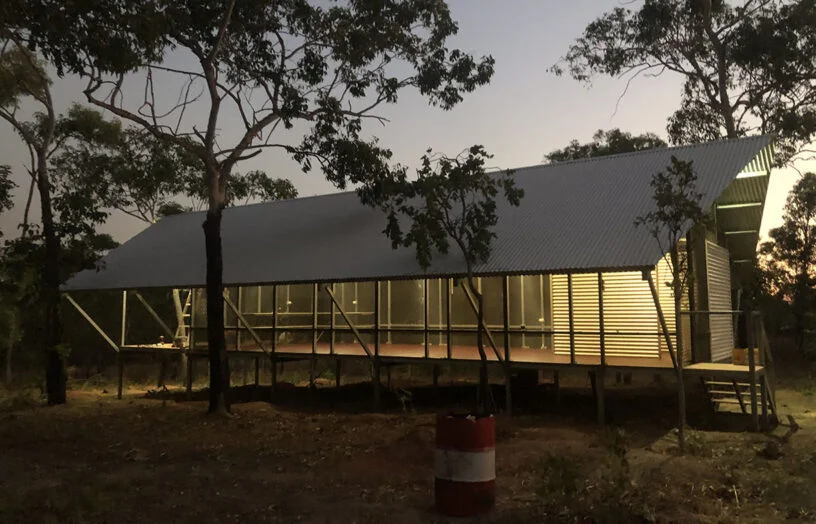
Rear view of home made from an old classroom

Current issue – portable classroom home

This simple, energy efficient home was once part of a school. It will be a place of learning once again when it opens for ReNew’s Open House Day in late July, writes Jacinta Cleary.

When it comes to building houses, Abbie Heathcote has tried almost everything.

READ MORE »

In the 1960s, Abbie, a painter of landscapes, was drawn to the bush at Kangaroo Ground on Melbourne’s northern outskirts, building a mudbrick home.

In the 1980s she built an inspired home near Castlemaine in Central Victoria. Everything was done by hand and building materials salvaged from the tip, the bush and the roadside including tree trunks, stone, mudbricks, rocks, cow dung and sand dug from the riverside. This was undeniably an artist’s home, with a roof garden and an indoor dry creek bed. It took almost five years to build.

It was a different story with Abbie’s current home in Castlemaine, with the project taking only 13 weeks to complete. She had a head start with this dwelling, as it is made from a single portable classroom.

Just 20 kilometres away in Kyneton is BRB Modular’s ‘graveyard’, home to hundreds of demountable ex-classrooms. Abbie found a classroom slightly larger than most, meaning she could include two bedrooms, small as they are, so that her daughter can stay from time to time. The home has similar proportions to an inner city apartment, with an open plan living and kitchen area and a small bathroom/laundry. The main difference is that this 60 square metre ‘box’ has a 24 square metre deck added to it, with views that will only get better once the newly-planted trees grow up.

Anyone who went to school in portable classrooms might remember that they were incredibly cold, at least in the midst of a southern winter. Heating the rooms was hopeless because they are essentially steel or timber shells. To counter this, Abbie has added wall, floor and ceiling insulation, with the wall and ceiling insulation made out of recycled plastic bags. During an early morning visit after an overnight frost there’s no heating on but the full sun coming through the windows is enough to keep warm. Abbie says the house can stay warm until 9pm.

Read the full article in ReNew 112
Click here for more details on ReNew’s Open House Day
Citroen EV

Dyane for a new millennium

When it came to converting a car to electric in New Zealand there weren’t a lot of options for Ulrich Schmid. Then he found a Citroen 2CV.

In 2002 I became aware that using oil (petrol/diesel) the way we were could not go on forever. I wanted to do something about it so I hunted around to buy an electric vehicle. I discovered that almost all car manufacturers made one or more model of electric car, including Toyota, Honda, GM, Ford, Chrysler, VW, Citroen, Renault, Fiat and Peugeot, just to name the most important ones. There was also the Twike, Hotzenblitz, Think and other small producers of electric vehicles.

READ MORE »

I could not afford an electric vehicle back then and it was impossible to import a left-hand-drive vehicle into New Zealand without owning it overseas. I decided to produce biodiesel from used vegetable fat and oil as an interim solution and have been running all our cars and tractor on 100% biodiesel since 2004.

I visited my mother in Switzerland in 2005 which gave me the opportunity to go to London to look at the only right-hand-drive electric vehicle available at the time, a Citroen Berlingo Electrique. There was a garage which serviced these vehicles and I was very impressed by them. Unfortunately they had stopped making them a month before I arrived.

The following year I became aware that MES-DEA in Switzerland were converting Renault Twingos and Fiat Pandas to electric, however, these brand new cars were rather expensive. I found an earlier model for a better price, but the company would only sell them in Switzerland and Northern Italy; I would have to own it for three months in Europe before I could bring it to New Zealand. I applied for an exemption from this rule but it was declined on the grounds that it was more dangerous to drive a left-hand drive vehicle in New Zealand! My options were running out. To buy a converted Hyundai Getz from Australia was as expensive as buying a Renault Twingo from Switzerland.

Read the full article in ReNew 112
ReNew 112

Happy 30th birthday ReNew! Discover the early years

Find out about the early days of the Alternative Technology Association and ReNew magazine

ReNew takes a trip down memory lane to mark 30 years of successful independent publishing and knowledge sharing on sustainability. ReNew 112 includes an article on one of ATA’s first members John Morgan—a sustainability pioneer who has been with the ATA since 1980. There’s also a special fold-out timeline to mark milestones in ATA’s 30 year history. Click here to buy your copy.

READ MORE »

The early days of the ATA makes for interesting reading. Way back in the year 2000 Andrew Blair wrote a fascinating history of the ATA to mark the 20th anniversary, which you can read here

VCR 2

The good parts inside old VCRs

If you’re the type of person who sees possibilities when confronted with useable parts, there’s plenty to inspire inside a VCR, writes Julian Edgar.

Now is a great time to be salvaging VCRs. With the move to DVD players and, even more significantly, digital video recorders, VCRs are being discarded in huge numbers. You can find them at the tip, at garage sales, even in kerbside rubbish pick-ups. The most you should pay is a few dollars, but more often than not they are free.

READ MORE »

So why would you bother salvaging a VCR? And wouldn’t it take hours to pull it apart to get the good bits? Well the answers are, respectively: lots of reasons and no. And contrary to what you might expect, the best bits are mechanical rather than electronic. The trick with salvaging VCRs is to quickly pull the thing apart, sort and keep the good bits and then get rid of the rest.

Here’s a typical starting point. This is what you might call a medium-age VCR. Older ones are better and heavy older ones are better again!

Why is this? The heavier a VCR, the better the quality of salvageable components inside. In fact, to go to extremes, the ancient U-matic video tape machines weigh an incredible amount (some can barely be lifted) and inside you’ll find engineering that is fantastic, including solenoids and switches.

On the other hand, a super lightweight VCR has generally less of everything you might want. However, any VCR is worth picking up for its parts. At the very least you should get a useful motor and a few other goodies.

Read the full article in ReNew 112
john_morgan_web

With ATA since the year dot

While the Alternative Technology Association (ATA) turns 30, John Morgan’s involvement with all things renewable spans a lot longer than three decades. Jacinta Cleary visits one of ATA’s first members in his energy efficient home.

On July 29, 1981, households around Australia were gathering around televisions to watch the wedding of Prince Charles and Lady Diana. Belinda Morgan, like most people, was preparing a big night in (with champagne and chocolates) to watch the wedding with a couple of friends and her husband John. John had other plans though, and went to a seminar about heat pumps held by the newly-formed Alternative Technology Association. That night around 40 members met to share stories about heat pumps and their possible applications in homes. While the royal marriage was over by the mid 1990s, John and Belinda’s own union is still going strong, despite a different opinion on what constitutes a ‘good night’.

READ MORE »

John Morgan joined the ATA in its first year in 1980 and has been a member ever since. While that involvement has spanned three decades, John says his interest in renewable technology has been more like 50 years, first triggered by an article in Radio Television and Hobbies magazine in 1960 (price two and six pence) about a home-made solar hot water system. John, completely taken by the article called ‘The solar heater, how to build it’ showed it to a friend in Fremantle where he was living at the time. His mate built the system, having previously heated his water with a wood heater. This experience triggered John’s interest in all things renewable: “Fifty years ago we didn’t have systems like this,” he says.

Pioneer
John describes himself as an “electronic hobbyist since the year dot.” Another apt description might be that John is ahead of his time, a pioneer of sorts, for solar power.

John’s first career was as a teacher, starting with a primary school class of 73 students in 1956 and then moving on to secondary schools, specialising as a physics teacher. In 1976 he devised a major project on solar power for his Year 11 physics class, with students building solar-powered appliances such as solar ovens and water heaters, using parabolic dishes as solar collectors. The students roasted a chicken in their very own solar oven and the project was repeated in years to come. John continued to lead the way on sustainability education, incorporating climate change topics into his classes from the mid-1980s. “Kids would go home, read the meter and report back,” he says. “My main point (back then) was that when students got married and went to build a house, that they would build a sensible house.”

Future-proof housing
John’s own passion for a low impact future shows through three homes he has designed, two of which he built. While there is renewed interest in buried pipe cooling systems today, John installed a simple buried pipe system under his new home in 1982. The Morgans were rebuilding after their Dandenongs home was destroyed in a house fire. When the drainage contractor was digging a trench for the new home John saw an opportunity to lay some interesting pipe work. “Do me a favour and dig that thing a foot deeper than usual,” he said to the contractor. John lay some 90mm PVC pipe in the trench. The contractor came back the next day to install the drainage pipes on top and filled it in with dirt. John’s PVC pipes came up through the slab floor and vented cool air into the house. “It was an idea I had in mind for years,” he says. “It worked well enough but was soon abandoned as the house was able to manage to stay cool itself.”

John’s next house was at Musk near Daylesford. It was built during the recession in 1992 so a combination of friends helping with the build and using recycled materials kept the costs down. John and Belinda installed a RAPS system on this home, a 2kW photovoltaic system, and have been living off the grid ever since. The property featured a micro hydro turbine until it was decommissioned in 2004 when rainfall dropped substantially. The reverse brick veneer house was the site for the first Sustainable Living Fair in 1998 (now known as the annual Sustainable Living Festival) when 6000 people visited over two days. The organisers expected around 600 people. Nevertheless John was more or less the perfect host, showing as many groups around the property as was humanly possible.

While the design for his current home, completed in 2008, was going through the planning process, it achieved a home energy rating of 9 Stars according to the FirstRate software. “It’s probably at least 9.5 or 10 Stars now with these drapes I’ve added.” I tell him that I haven’t come across any other Australian homes with such a high rating (a new compulsory 6 Star rating is only just being introduced in all states). “No I haven’t either,” he says casually, quite comfortable to be ahead of the pack.

The house looks to the future both in name and intention. It’s named Galaxy Hill because the local area has good skies for star gazing; he hopes to build an observatory at home one day. “It’s a climate changed house,” he says. “I’ve designed it to take on board changes in the climate.” The house has views of the 129 turbine Waubra wind farm just fifteen kilometres to the east. A few kilometres to the south of his property, possibly visible above the treetops, will be a smaller 29 turbine windfarm. It’s fitting that John’s retirement property will end up with views of wind turbines on two sides, although he chose the site because of its excellent solar and wind power potential.

Read the full article in ReNew 112.