Renew 167 out now: Renewables in regional communities, hard rubbish pick-up, buying sustainable energy from the grid, the impacts of artificial intelligence on the environment, and much more!
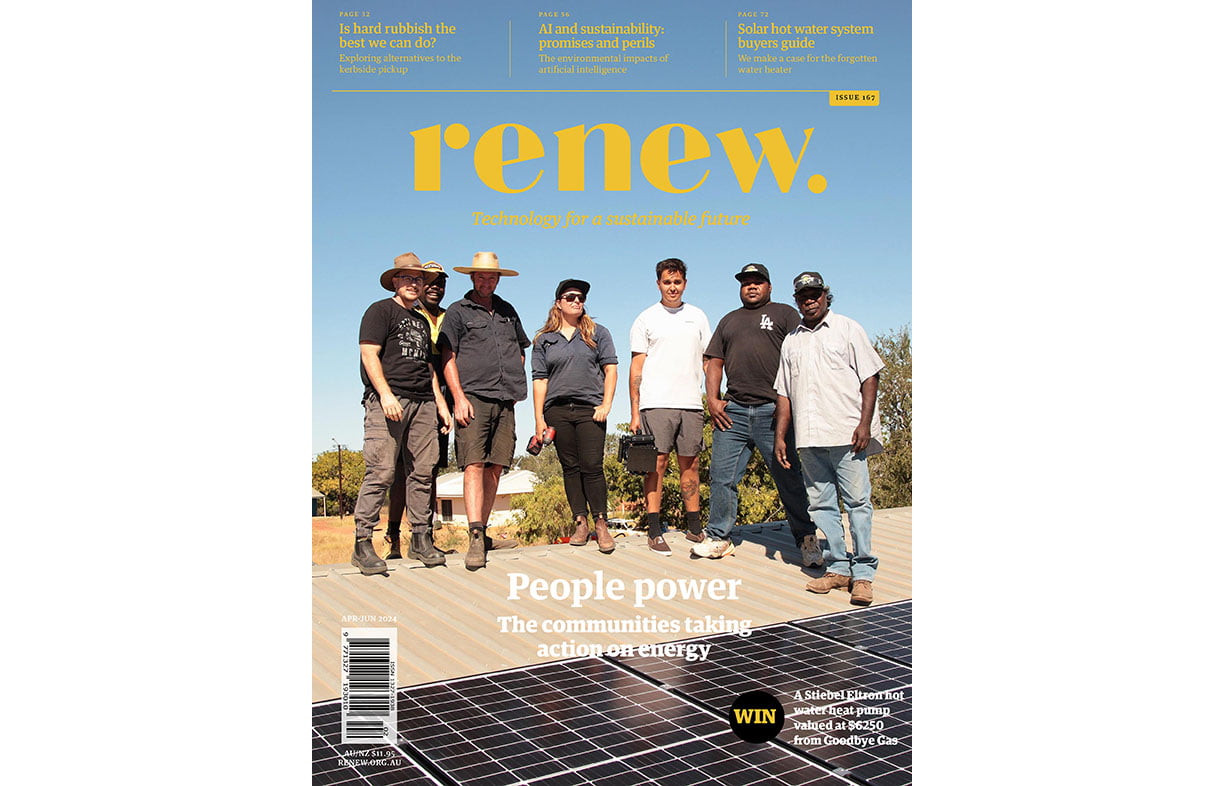
In Renew 167, a strong theme of grassroots community action runs through this issue, kicking off with our feature interview with the Bunyip Renewables Action Group, who are on a mission to significantly reduce their town’s carbon footprint and transition its energy use to 100% renewables by 2030. We then head to some of Australia’s remote communities to learn about the projects underway to address energy insecurity, including microgrids, solar farm developments and low-energy buildings inspired by traditional structures.
Also in this issue: our solar hot water system buyers guide; a simple retrofit to eliminate the shower fan; we unpack some of the hard truths associated with disposing hard rubbish; and energy policy specialist Dean Lombard gives a masterclass on buying sustainable energy from the grid. Plus, Rob Mcleod shares Renew’s latest research on the importance of utilising forward-looking climate data for home energy ratings. And much more!
Renew 167 is on sale now and available to purchase in newsagents. Or, you can always subscribe, and guarantee you’ll get every issue delivered to your door.
further reading
 Policy
Data in the city and the invisible impact of the cloud
As AI and cloud computing drive a boom in data centre construction, Australia faces growing questions about how these energy-hungry facilities will affect electricity demand, local communities and the transition to net zero. Mia-Francesca Jones examines the trade-offs—and asks whether Australia can build the cloud more sustainably.
Read more Products
Product profile: Tiny homes your way
One of the many advantages of a tiny home is their flexibility; being able to configure one online, and see the actual cost in real time, is a great idea that many more tiny home suppliers need to adopt.
Read more Pears Report
Signals of change
From global risk assessments and climate adaptation to the complexities of ‘free’ electricity offers, Alan Pears looks at some of the forces driving change in Australia’s economy and energy system.
Read more